
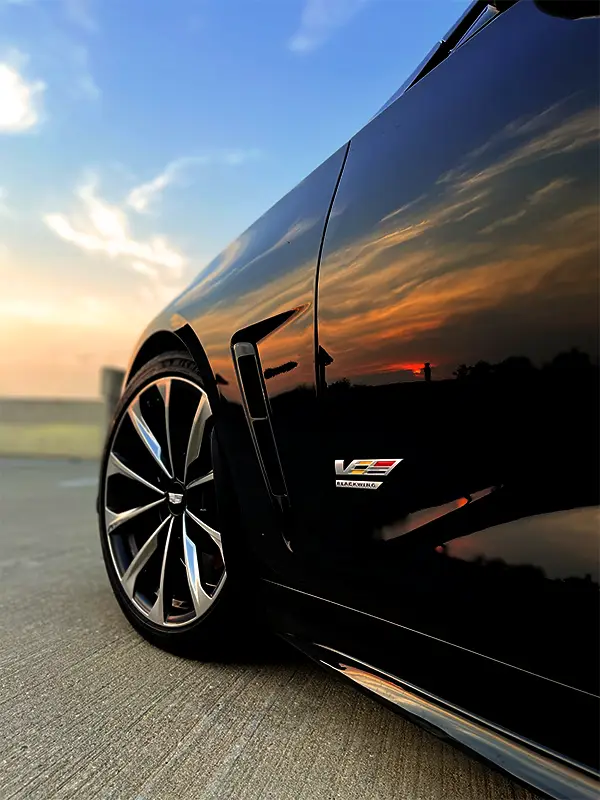

American carmakers have long trafficked in high-performance vehicles, from sports cars to muscle machines to potent pickup trucks, but there’s one …
How the Cadillac V-Series Changed Sport Sedans Forever
The luxury sport sedan segment was once thought to belong exclusively to European brands. BMW M, Mercedes-AMG, and Audi Sport carried the reputation for delivering cars that combined comfort, sharp handling, and powerful engines. American automakers were associated more with muscle cars, trucks, and SUVs than with precision sport sedans. That all changed in 2004 with the arrival of the Cadillac CTS-V and the launch of the V-Series. The moment marked the beginning of a new chapter in performance luxury, and it is the story of how the Cadillac V-Series changed sport sedans forever.
The V-Series broke through long-held stereotypes about Cadillac. For decades the brand represented older buyers, soft-riding cruisers, and chrome-heavy luxury. The first CTS-V redefined that image. With a 400-horsepower Corvette-derived V8, a manual transmission, and suspension tuning tested on the Nürburgring, Cadillac suddenly offered something no one expected: a legitimate American rival to the European benchmarks. Reviewers were stunned, and enthusiasts saw Cadillac in a new light. This shift was more than just about performance numbers. It was cultural, showing that Cadillac could reinvent itself and win credibility with drivers who valued speed and precision.
As the lineup evolved, Cadillac refined its formula. The second-generation CTS-V introduced a supercharged V8 and delivered staggering acceleration, while the third-generation model pushed the envelope even further, producing exotic-car levels of performance. Importantly, Cadillac also expanded the V-Series family. Models like the ATS-V and CT4-V Blackwing gave enthusiasts entry-level options without sacrificing driving engagement. The CT5-V Blackwing, with its supercharged 6.2-liter V8 and available manual transmission, became a symbol of defiance in an era when competitors abandoned manual gearboxes and moved toward hybridization.
The influence of the V-Series reshaped how performance sedans are viewed globally. Before its arrival, German brands rarely had to look at American offerings as serious rivals. Once Cadillac started producing V-Series cars that reviewers compared directly to the BMW M5 or Mercedes E63, the conversation shifted. Cadillac was no longer an outsider. It was a competitor that could match or even surpass rivals in certain performance metrics, often at a lower price. In doing so, Cadillac forced enthusiasts to question whether the prestige of a European badge was the only way to measure sport sedan excellence.
Part of what made the V-Series unique was its blend of character. These cars carried the raw power and sound of American muscle while being engineered with the handling finesse of European rivals. Few cars before had struck that balance. The result was a lineup that felt distinctly American but still delivered world-class performance on road and track. That identity set Cadillac apart in the crowded performance market.
The V-Series also demonstrated how a brand could honor tradition while embracing the future. Cadillac’s modern V-Series lineup exists alongside its cutting-edge V-Series.R hypercar, which competes in international endurance racing at IMSA and Le Mans. The connection between road cars and motorsport gives the V-Series credibility while signaling Cadillac’s long-term commitment to performance even as electrification takes hold.


