
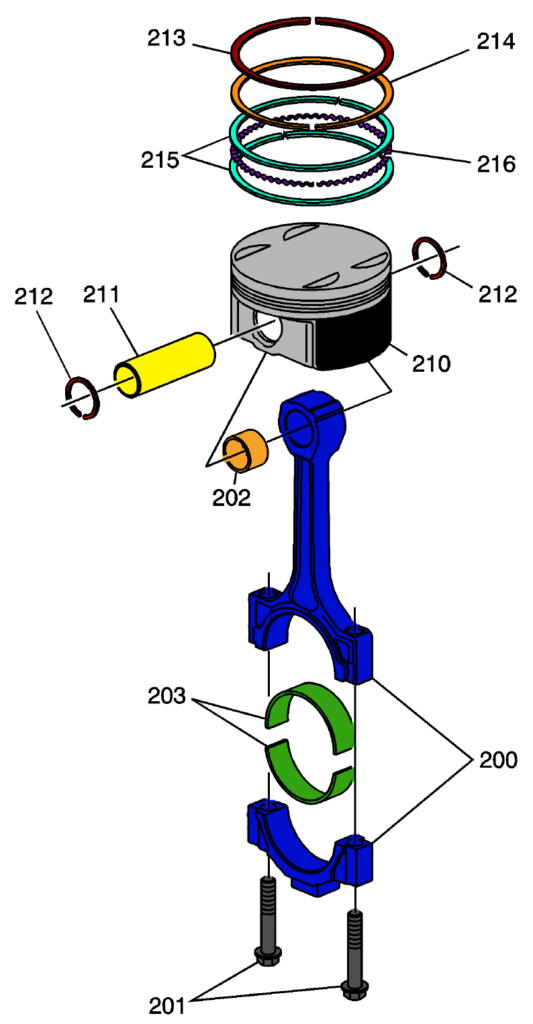
(200) Connecting Rod
The connecting rod links the piston to the crankshaft. It transmits the force from combustion down to the crankshaft and converts the piston’s linear motion into rotational motion.
(201) Connecting Rod Bolt
These high‑strength bolts clamp the connecting rod cap to the rod body. They are critical fasteners that maintain bearing crush and alignment under high load and high RPM.
(202) Connecting Rod Bushing
A small bushing installed in the small end of the connecting rod. It provides a smooth, low‑friction surface for the piston pin, helping the assembly pivot freely.
(203) Connecting Rod Bearing
Shell bearings located in the big end of the connecting rod. They support the crankshaft journal with a thin film of oil, allowing the crank to spin smoothly without metal‑to‑metal contact.
(210) Piston
The main moving component in the cylinder. The piston compresses the air‑fuel mixture and transfers combustion pressure to the connecting rod. The piston crown, ring lands, and skirt are all visible in the illustration.
(211) Piston Pin (Wrist Pin)
A hardened, cylindrical pin that passes through the piston and the connecting rod bushing. It allows the piston to pivot relative to the connecting rod during the engine cycle.
(212) Piston Pin Retainer
Small retaining clips that lock the piston pin in place. They prevent the pin from moving sideways and contacting the cylinder wall.
(213) Piston Upper Compression Ring
The top ring in the ring pack. It seals the combustion chamber, helping to contain pressure and improve power and efficiency. It also plays a key role in controlling blow‑by.
(214) Piston Lower Compression Ring
The second compression ring. It provides additional sealing and assists in scraping excess oil from the cylinder walls, working together with the top ring and oil ring.
(215) Piston Oil Control Rail Ring
The thin outer rails of the oil control ring assembly. They help meter and scrape oil off the cylinder wall, returning it to the crankcase while preventing excessive oil from entering the combustion chamber.
(216) Piston Oil Control Ring Spacer
The wavy spacer that sits between the oil control rails. It applies outward tension, pushing the rails against the cylinder wall to improve oil control.



LF4 Pistons: Forged for Boosted Applications
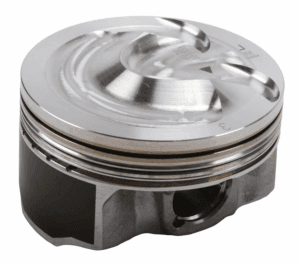 The LF4 uses forged aluminum pistons, designed with forced induction in mind. Under twin‑turbo operation, the pistons must manage:
- High cylinder pressures
- Elevated combustion temperatures
- Repeated thermal cycles during hard use
Key characteristics of the LF4 pistons:
- Forged construction
Offers better strength and resistance to detonation compared to typical cast pistons, especially in performance and tuning environments.
- Forged construction
- Dish and crown design
The piston crown and dish shape are optimized for the LF4’s direct injection combustion system and compression ratio, balancing efficiency, knock resistance, and power potential.
- Dish and crown design
- Cooling and durability features
The pistons are designed to work with oil squirters and modern cooling strategies to help manage piston crown temperature under load.
- Cooling and durability features
For anyone considering higher boost levels or aggressive calibration changes, the factory forged pistons are an advantage compared to many non‑performance OEM turbo engines. They have been seen to support 600+ hp levels.
Piston Rings: Sealing, Control, and Friction
 The piston ring pack in the LF4 is designed to work with:
- Direct injection
- Turbocharged cylinder pressures
- Emissions and fuel economy constraints
Typical features of a modern performance ring pack like this include:
- Top ring
Provides the main combustion sealing. Often made from a durable steel or iron alloy with a coating to resist wear and protect against high temperatures.
- Top ring
- Second ring
Assists in compression sealing and aids in oil control. It also helps manage gas blow‑by and stabilize the top ring.
- Second ring
- Oil control ring
Scrapes and controls the oil film on the cylinder wall, ensuring sufficient lubrication without allowing excess oil consumption.
- Oil control ring
For tuning and track use, maintaining good ring seal and cylinder finish is important. Proper break‑in, oil selection, and maintenance directly affect ring performance and blow‑by behavior in the LF4.
Rod Bearings: Supporting the Rotating Assembly
The rod bearings form the interface between the connecting rods and the crankshaft journals. In the LF4:
- They must handle high specific loads due to turbocharging and relatively high cylinder pressures.
- Oil quality, viscosity, and pressure are critical to protecting the bearing surfaces.
- Proper clearances are important, especially when the engine is subjected to extended high‑RPM use or higher‑than‑stock torque levels.
Common focus areas with LF4 rod bearings:
- Oil choice and service intervals
High‑quality oil and reasonable change intervals help maintain film strength at the bearing surfaces.
- Oil choice and service intervals
- Tuning and knock control
Detonation and uncontrolled cylinder pressure spikes can drive loads into the bearings and reduce their life.
- Tuning and knock control
- Track and high‑RPM driving
Consistent high‑RPM operation increases bearing load and temperature, making oil pressure and temperature management more important.
- Track and high‑RPM driving
Connecting Rods: The Key Difference Between LF4 Variants
The connecting rods are one of the most important distinctions between various LF4 applications. The rod design and supplier tell you a lot about the expected duty cycle and performance envelope.
There are two main rod setups to focus on:
- GM genuine Pankl rods – ATS‑V and manual CT4‑V Blackwing
- Steel rods – automatic CT4‑V Blackwing
Pankl Connecting Rods in ATS‑V and Manual CT4‑V Blackwing
 In the Cadillac ATS‑V and the manual‑transmission CT4‑V Blackwing, the LF4 is equipped with GM genuine Pankl connecting rods, part number 12652977.
https://pankl.com/racing/en/divisions/racing/
Pankl is a specialist in the development, design, manufacturing, and testing of:
- Crank mechanisms
- Pistons
- Piston bolts
- Connecting rods
- Crankshafts
- Turbo applications
- Complete transmission and chassis systems for the racing sector
Their background is rooted in motorsport and high‑stress applications, which aligns with how many owners use the ATS‑V and manual CT4‑V Blackwing: track days, hard driving, and performance modifications.
Key takeaways about the Pankl rods (PN 12652977):
- They are engineered with racing‑sector experience, which influences design, material choice, and quality control.
- They are intended to handle high cylinder pressure, high RPM, and frequent load cycles.
- For enthusiasts planning significant tuning or track use, these rods are a strong foundation inside the factory LF4.
Because these rods are GM genuine Pankl pieces, they offer motorsport‑grade design within an OEM production engine, which is relatively uncommon.
Steel Rods in the Automatic CT4‑V Blackwing
In contrast, the automatic CT4‑V Blackwing uses steel connecting rods under part number 12641607.
These rods are still designed for a performance application, but they do not share the same Pankl branding and motorsport background as the rods in the ATS‑V and manual CT4‑V Blackwing.
Characteristics and considerations for the steel rods (PN 12641607):
- They are conventional steel rods designed to handle the factory power and torque levels for the automatic CT4‑V Blackwing.
- Engineering priorities include durability, manufacturability, cost, and compatibility with the automatic transmission’s torque delivery and use case.
- While suitable for stock and mild upgrades, they are not positioned the same way as the Pankl rods from a motorsport or “race‑sector” perspective.
For owners considering higher power levels on an automatic CT4‑V Blackwing, the rod choice is an important factor to include in the planning. Power targets, RPM limits, and usage (street vs. track) should all be considered when deciding whether to retain the factory rods or move to an upgraded set.
Why the Rod Difference Matters
The difference between Pankl rods (12652977) and steel rods (12641607) is not just about the brand name. It reflects:
- The intended use case of each vehicle configuration
- The expected duty cycle and abuse level
- How GM balanced cost, durability, and performance across the lineup
Enthusiasts and builders who are choosing an LF4 core or planning upgrades often focus on:
- Whether the engine came from an ATS‑V or manual CT4‑V Blackwing with Pankl rods
- Or from an automatic CT4‑V Blackwing with standard steel rods
This difference can influence both reliability expectations at higher power levels and the budget required for a full build.

CT4 Blackwing Wallpapers

GM LF3 vs LF4 Differences in the V-Series Cadillac

Q1 2026 Update: The Edge of Excellence in Cadillac Performance

How the Cadillac CT5-V Blackwing Is Built: Inside the Factory and Curated by Cadillac Program
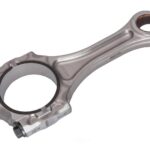
LF4 Pistons, Rings, Bearings, and Pankl Connecting Rods in the ATS‑V and CT4‑V Blackwing

